What is a timestamped photo or video?
A timestamped photo or video, sometimes referred to simply as a “timestamp,” is a simple method of proving ownership of a certain card or collection. While not foolproof, it is a simple deterrent against scammers who may be reusing existing photos of someone else’s collection. A timestamp almost always also includes a handwritten note containing the current date, time, and both parties’ full names clearly visible. Do not print out timestamp elements or digitally superimpose them.
A timestamped photo or video should be taken in a well-lit room, have all cards visible (it is okay to split a timestamp into multiple photos), and be reasonably high quality. Almost all modern smartphones take high-quality photos.
View timestamp examples
| Good timestamp | Bad timestamp |
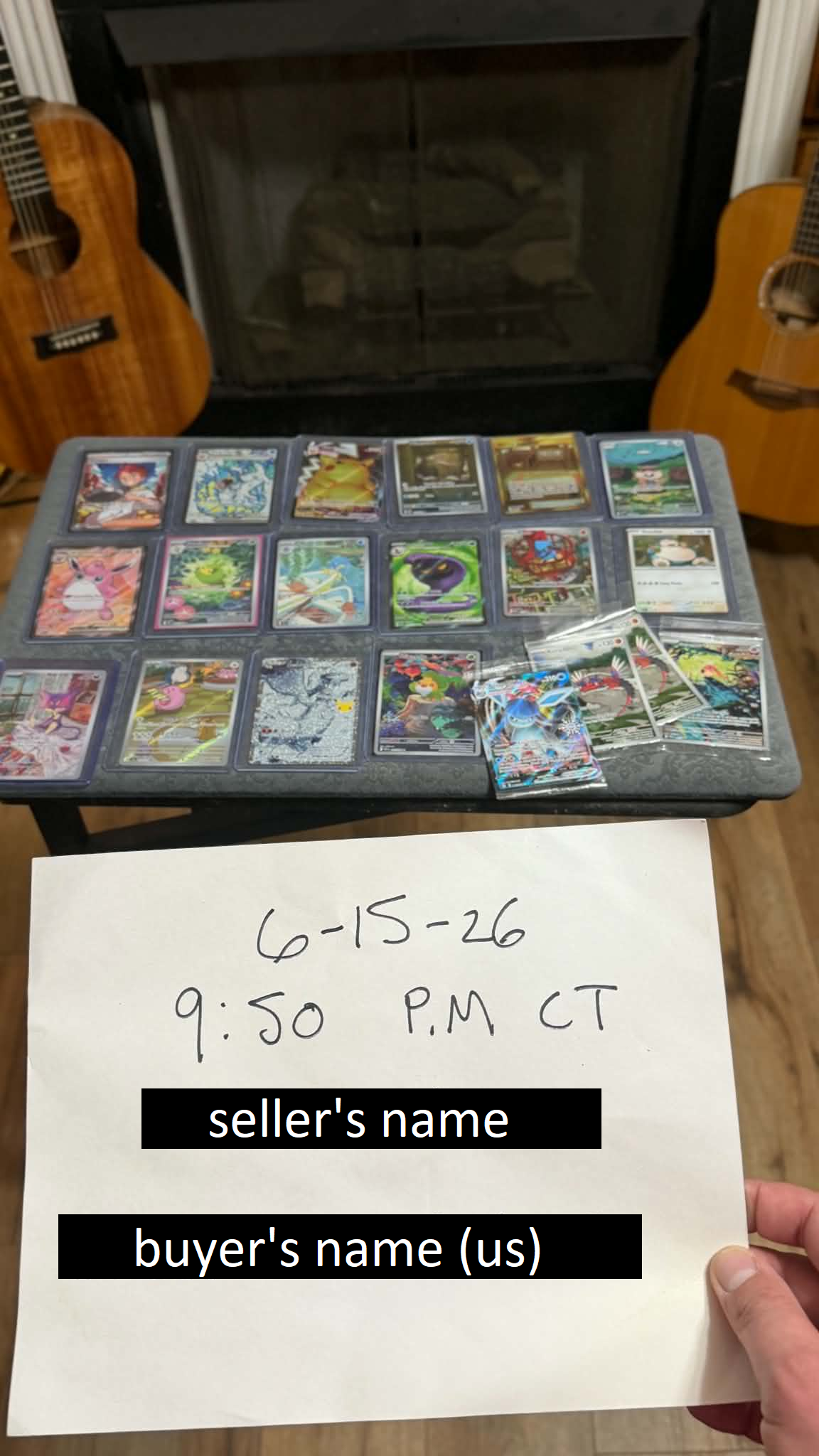 |  |
| 1. The note is handwritten and clearly visible with the cards. 2. The current date, time, and both party's names are prominent. | The timestamp is missing, not clearly shown with the cards, or mostly illegible. |
Why can’t you cover PayPal’s Goods & Services fee?
When issuing an invoice with PayPal or generally accepting non-F&F payments, you agreed, with PayPal, to be responsible for all relevant fees as part of their User Agreement. Passing on a 2.99% invoicing fee (generally referred to as the “G&S fee”) to a buyer is against their TOS, AUP, and Seller Agreement.
Why can’t you accept PayPal Friends & Family?
Sending payments with PayPal’s Friends & Family payment option provides zero buyer or seller protection. It is also against PayPal’s User Agreement to ask a buyer to send a payment using F&F.
Why don’t you accept other payment methods?
PayPal’s Goods & Services payment method offers the strongest buyer and seller protections for the lowest cost and barrier of entry. Almost all people in the US can easily obtain a verified PayPal account. If you are unable to obtain a PayPal account (such as if you are underage or have previously been banned from the platform), we are unable to deal with you.
Common alternative payment methods offer little or no buyer or seller protection, are non-refundable (e.g., Zelle or Wise), or do not have reasonable verification methods (e.g., cash, cryptocurrency).
Why can’t you cover shipping?
It is the responsibility of the seller to cover all relevant shipping, postage, and/or insurance charges related to shipping. Postage is a necessary business expense of the seller. All offers made by us include all postage and other relevant fees incurred by the seller.